

Chennai Metro’s Last Mile Crisis - a Case Study ft. Little Mount Station

Author: Santhosh Loganaathan Edited by: Aishwarya Soni
This blog was originally written as a script for a video essay produced by Nagariyal, now available on youtube (linked below). All sources are linked in the article or in the footnotes in verifiable formats.
Little Mount metro station sits in the heart of Chennai. Around 45,000 people live within a 10-minute walk [1], and over 130 bus routes pass through it [2]. Some of the biggest educational institutions, high-rise offices, and luxury hotels are in close proximity. The station is also the closest connection to Chennai’s IT Corridor.
On paper, this should be one of the busiest metro stations in India. But only about 8,000 people use it every day [3].

Why such low patronage?
When Chennai Metro was launched in June 2015, Chennai Metro Rail Limited (CMRL) had estimated that, by 2026, 12 Lakh people will use the metro system everyday. But today, the current daily ridership averages at just around 3.44 Lakhs – less than a third of that target.
This phenomenon of lower-than-projected ridership is not unique to Chennai, but prevalent in almost all metro systems in India [WRI India, 2023]. Studies cite several reasons for such underperformance including reasons like high fares, network gaps, inadequate trains and coaches, etc. But the most commonly cited challenge across studies is the lack of last-mile connectivity — the everyday struggle of reaching the Metro station. [CSE India, 2019; The Infravision Foundation; Paulose N Kuriakose, 2025; WRI India, 2023]
In this series, we take a closer look at a few key stations to understand Chennai Metro Rail’s last-mile crisis, how it contributes to the stagnated ridership, and potential ways to resolve it. We begin with the Little Mount station.
Setting the Context: Little Mount Station
The Little Mount station is part of the Blue Line and is an elevated station right above Anna Salai, close to high-density residential neighbourhoods, high-rise offices, and large academic institutes. Presently, this station is the nearest metro connection for areas such as Adyar and Thiruvanmiyur, and the city’s IT corridor along Old Mahabalipuram Road (OMR).
There are three bus stops within a five-minute walking distance that collectively serve 130+ Bus routes, which is nearly 20% of all routes operated by the Metropolitan Transport Corporation (MTC) [2]

CMRL in partnership with MTC also operates a feeder bus service, the S98, that connects the Little Mount station to the Taramani Bus Terminal via Anna University, IIT Madras, Ramanujam IT Park, TIDEL Park, Ascendas IT Park, etc, effectively enabling access for over 1 Lakh people studying or working in these campuses. [4]
But despite its favourable location, and such a large catchment, only around 8,000 passengers use this station during the weekdays [3], raising questions about unrealised potential. Why are more people not using the metro here?
To answer that question, we first need to understand who currently uses the metro and how they actually get there. We can broadly classify them into three categories.
Who uses the Little Mount Metro Station?
Based on how people get to the metro station, we can broadly classify them into three categories
People who walk or take public transportation (in the case of Little Mount, it’s Bus)
People who get dropped off at the station (by autos, cabs, friends / family, company vehicles, S98 feeder bus)
People who bring their own vehicles to park-and-ride.

We look at the last mile experience of each of these groups.
People who walk to the station or take public transportation
We include the people who take public transportation in this category because eventually they get-down from their bus and walk to the station. Irrespective of how a person travels, their journey almost always ends or begins on foot. So footpaths aren’t a “nice-to-have” infrastructure. They’re the most fundamental infrastructure for any city.
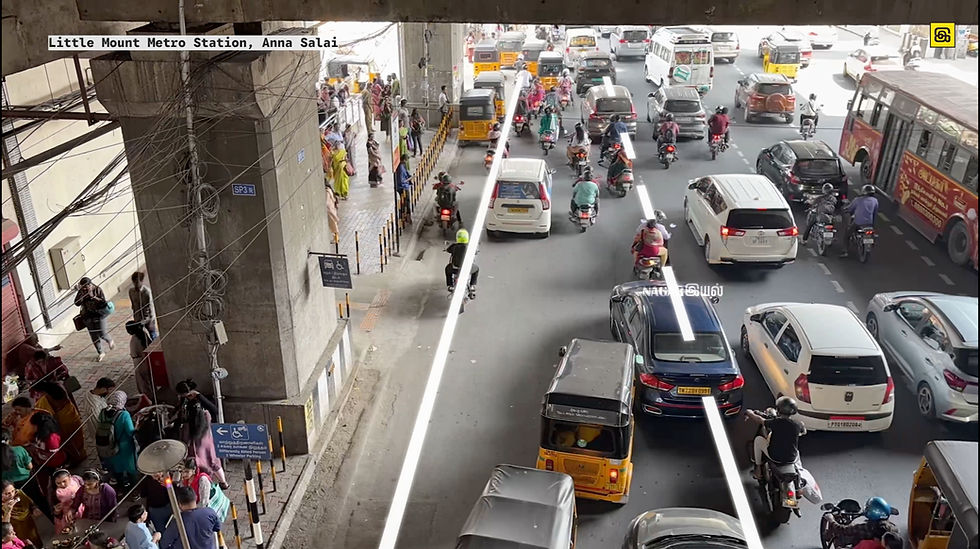
But on the roads around Little Mount station, they're either blocked, broken or non-existent. Obstructions like wires, waste, and vehicles, are a common-sight. It’s nearly impossible to find a continuously even surface to walk on, and having to squeeze between the crude bollards placed to prohibit vehicles from riding on footpaths makes it even worse.
As a result, even walking to the nearest bus stop–just 150m away–puts pedestrians directly in conflict with speeding vehicles. The walk to the other two bus stops–that are about 400m away in either direction–is even more difficult due to the lack of designated pedestrian crossings. Even in places where crossings exist, it’s very common to see vehicles ignoring them and speeding through, directly endangering pedestrians.

The roads around the Little Mount Station (Anna Salai, Taluk Office Road, and Sardar Paterl Road) are designed for four lanes of one-way traffic as per the road markings, but it’s very common to see 6-7 lines of cars going side by side. A four-lane carriageway should ideally be around 14-15 metres going by the Indian Roads Congress standard of 3.5 metres per lane [IRC: 86-2018, Geometric Design Standards for Urban Roads and Streets]. But the carriageway here varies between 18 to 21 metres. This expansive, poorly designated carriageway, leads to bad behaviours such as frequent instances of overspeeding, wrong-side driving, erratic and unpredictable lane merging, and unorganised on-street parking.

For the ~45000 people living within the station’s influence zone, and for the thousands of bus passengers boarding/alighting at the nearest three bus stops, the poor walkability around this station makes the access to the metro station feel uncomfortable, unsafe, and utterly unpleasant.
People who get dropped off directly at the station
This includes people who arrive by any shared-transport mode such as autos, taxis, bike-taxis, or those dropped-off by friends, family, or even company vehicles. We also include those who take the S98 feeder buses in this category. All these users get dropped off at the designated pickup/drop-off point at one of the two entrances to the station.
Signs near the station entrance gates indicate pickup/drop-off zones, but road markings do not reflect that. For someone driving, the signs are too small and the road markings suggest that vehicles can drive through. This confusion turns the drop-off area into a high-conflict zone, putting both Metro commuters and vehicle users at the risk of a crash.
The drop-off zone is also inadequate for the number of vehicles. Although the S98 feeder buses are scheduled to halt only for five minutes, they frequently stop for at least ten minutes, leading to drop-offs spilling over into adjacent traffic lanes and creating traffic bottle necks.
For people with disabilities, wheelchair users, pregnant women, and older adults, the high-floor feeder bus is difficult to use or not usable at all. These feeder buses operate at a frequency of once every 30 to 40 minutes. A WRI India study conducted in three Indian cities finds that if accessing the Metro takes longer than 20 minutes — including the wait time — very few users consider taking it. Women are particularly averse to waiting for long [Mukherjee et. al. 2023. “Improving Metro Access in India: Evidence from Three Cities” Working Paper. WRI India]
Despite that, the feeder buses run overcrowded during peak hours. These buses have a capacity of 21 passengers and operate a total of 28 times in a day. Even if we assume 100% capacity on all its trips, these buses bring in about ~600 commuters to the Little Mount Metro station each day— a mere 7.3% of the total ~8200 daily commuters. This points to an urgent need to increase the frequency of these feeder buses.
People who park their personal vehicles at the metro parking
This includes anyone who comes by their own vehicles like cycles, motorbikes, or cars to park at the station and take the metro. As is evident from a 2009 press release by CMRL or even their latest annual report, CMRL has consistently prioritised increasing the parking capacity at the stations to facilitate “Park-and-Ride”.
CMRL operates two parking lots at the Little mount station, One exclusively for two-wheelers which can accommodate up to 150 motorcycles, and another lot that can accommodate 39 cars and 185 motorcycles making the total parking capacity 374 vehicles. [Source: CMRL Parking Availability]
According to CMRL’s own data, the parking spaces at the Little Mount station get fully occupied before 10am on most days. [5]
Bike and Car drivers when they arrive at the station with the intention to park-and-ride and find there is no space to park, face three choices.
Park illegally on the footpath or nearby streets
Drive to the next station and try there.
Just give up on the metro and continue driving to their destination instead.
Option one makes things even more difficult for the pedestrians. Option three defeats the entire purpose of building a metro, which is to remove vehicles from the road.
And if someone repeatedly faces this uncertainty with parking, they might just stop considering the metro as an option for their everyday commute and take whatever mode is immediately available to them, which in most cases will be their own private vehicle.

CMRL’s parking flow data shows that in a given day only about 500 unique vehicles use the 374 parking spaces in Little Mount [6]. Which indicates that the parking is mostly used by people who park all day and go to work/study. When we were in the field, we observed that most vehicles were single occupancy. But even if we generously assume double occupancy for all vehicles, the number of people taking the metro who arrive using their own vehicles is only about 1000 per day, or 12.2% of all users.
There was no data on the availability of bicycle parking.
Overall, the last-mile experience includes (but not limited to) a hostile walking environment, inadequate and unsafe pick-up/drop-off zones, low-frequency and over-crowded feeder service, and inefficient parking provisions.
Investing in the Last Mile for Greater Metro Patronage
Based on our calculations, among the 8000 weekday commuters at Little Mount:
80% users (6400) walk / take bus / use para-transit / get dropped-off
8% users (600) use feeder buses
12% users (1000) park-and-ride

Improving the last-mile connectivity can increase the ridership. But this is not just the responsibility of CMRL; it involves other institutional actors too, such as the Greater Chennai Corporation, Highways Department, MTC, Greater Chennai Traffic Police, and CUMTA. Together, they must:
Fix the footpaths: Walkability is the foundation for urban transport. Take any successful rapid-transit systems from around the world, and pedestrians form the largest group of patrons. No amount of parking or buses compensates for a road you cannot safely walk on. Wheelchair-accessible footpaths with safe pedestrian crossings that’s shaded during the day, and well-lit during the night are non-negotiable infrastructure.
Redesign the pickup/drop-off zone: with clear road markings, proper signage, and a dedicated space that ensures that there are no conflicts between vehicles that pickup/drop-off people and the moving traffic. Getting out of a car or bike or the bus shouldn't risk one's life.
Increase frequency of the feeder buses: Waiting 30-40 mins for a bus will not encourage more users to consider it as an option. Running buses every 5-10 mins will attract more people by ensuring reliability. The demand is already there. The supply needs to be fixed.
Optimize Parking: One car parking spot for a single driver wastes space that could serve 5-6 bikes or 8-10 cyclists. Provide more parking space for cycles, and disincentivise cars carrying only one person. [Refer: Reinventing Parking]
Beyond these, solutions like feeder share-autos, bike-share systems, and bicycle networks should be implemented with careful planning. In the long-term, area-level parking management systems should be implemented. On-street parking can generate enough revenue to maintain footpaths and cycle-sharing systems. [Refer: Parking Benefit Districts]
If Metro systems are built to move people, we need people-centred planning, policy, and design — not just within the stations and trains, but also in how people reach the Metro.
Delivering this requires stronger political will to ensure that multiple institutional actors cooperate, coordinate, and function to provide one unified experience. The push for metro cannot end with demands for expansion and new lines alone; it must extend to demands for investments and improvements in last mile connectivity: a crucial part of the Metro experience that determines how people access the system to begin with.
With seamless first- and last-mile connectivity, the overall journey quality gets elevated. More people will choose the metro when access options are easy, safe, reliable, and affordable. Only then can we bridge the gap between projected and actual ridership and unlock the full potential of Chennai’s high-quality metro system.
To cite this article:Chennai Metro Rail’s Last Mile Crisis - Case of Little Mount Station by Santhosh Loganaathan, Nagariyal (April 2026)
—-----------------------
Footnotes:
Based on isochrone analysis of 10-minute walking radius from Little Mount Metro; Population data source: WorldPop. (Link to GIS File)
Bus Routes Data scraped from multiple sources including MTC, ChennaiOne, Scribd and Ithu Ungal Soththu. (Link to spreadsheet)
Passenger Flow Data downloaded from the CMRL website from 21st Feb to 27th Feb. Data is made available by CMRL only for the present day and the previous day. (Link to spreadsheet)
Data extracted from multiple sources
Data taken from CMRL’s parking availability realtime dashboard.
Parking Flow Data downloaded from the CMRL website from 21st Feb to 27th Feb. Data is made available by CMRL only for the present day and the previous day. (Link to spreadsheet)


Comments